
Abstract
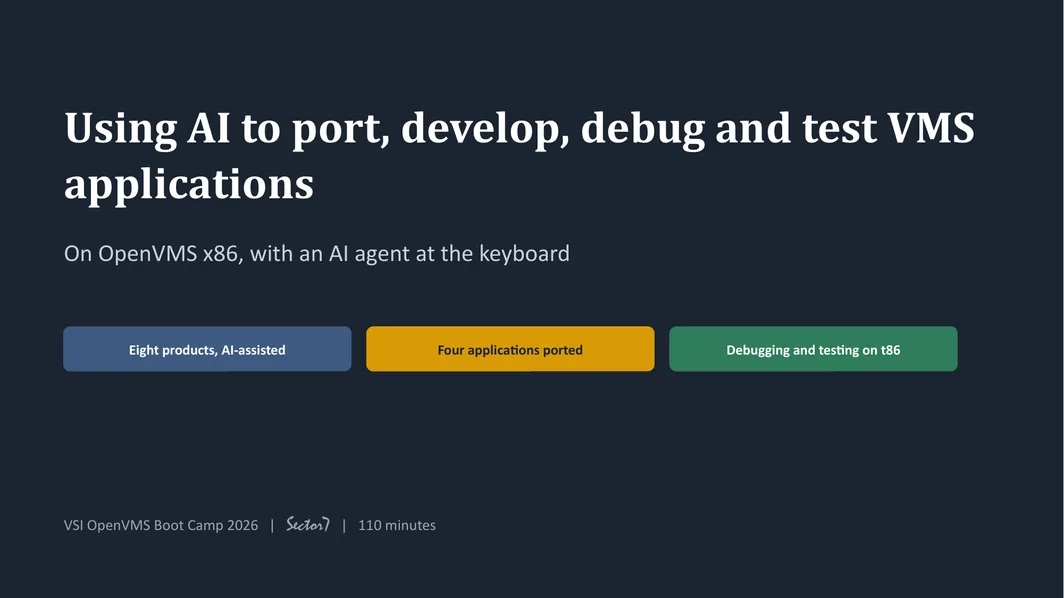
AI coding agents can now work on OpenVMS the way a contractor does: over ssh with a key, one DCL command at a time, with batch jobs, logs and screen captures as their evidence. This session shows what that looks like in practice on OpenVMS x86, drawn from Sector7’s recent work.
It opens with how an agent reaches a VMS host, what the model already knows about VMS and where it goes wrong, and the working rules that keep it honest: no guessing, nothing skipped silently, measure the real system rather than recall it. It then covers eight products built with AI, among them a SQL$PRE-compatible precompiler and runtime, an RDML translator, a CDD replacement whose shareable image had to match the real symbol vector index for index, a wire-compatible Tuxedo, VX/DECFORMS for TDMS, EDT and TPU editors, and a from-scratch ACMS for Linux proven keystroke for keystroke against a real ia64 system.
Four application codebases follow, anonymised: an accounting system in VAX BASIC and FMS, a banking application on Tuxedo and ACMS, a five-million-line manufacturing suite in Pascal, RDML and TDMS, and HP’s own AVERTZ, rebuilt on x86 against PostgreSQL with DECdtm two-phase commit. For each, the talk walks the same four steps: analyze the code base, analyze the build, build the executables, create the installable kit.
The closing parts show the agent debugging, from a line in a log to a fix with evidence before and after, and testing, with batch-job matrices, a robot that walked 551 menu screens, PTY drivers for DECforms, and gates that are accepted only after they have been seen to fail. Every number in the deck traces to a command, a commit, or a capture.
What the talk covers
- Products Sector7 has created with AI assistance, including VX/EDT, VX/TPU, VX/SQL, VX/RDML, VX/CDD, VX/TUXEDO, VX/DECFORMS for TDMS, and ACMS for Linux.
- Four application codebases ported or taken to proof-of-concept: what they are made of, and the steps the AI took to analyse, build and package them.
- Using AI to create an EDT editor: one prompt, a Ralph loop, and a real VMS host to measure against.
- Using AI to port AVERTZ to x86 OpenVMS: HP’s ACMS verification program with COBOL, embedded SQL, DECforms, VX/CDD and DECdtm, rebuilt on x86 against PostgreSQL.
- How the agent reaches OpenVMS over ssh, scp and sftp, with one DCL command per call, batch jobs on SYS$BATCH, and transcripts that trace every claim.
- Using AI to debug an application, from a line in a log to a fix with evidence before and after.
- Using AI to test an application: batch matrices, screen robots, PTY drivers, lockstep against a real system, gates that must fail first.
Slides