BASIC Commercial Applications
Sector7 specializes in complex OpenVMS BASIC migrations, ensuring a smooth transition to modern Linux-based infrastructures while maintaining the integrity and performance of your commercial applications. Our toolset bundles streamline the migration process, automating key conversions and reducing the need for costly redevelopment.
-
OpenVMSBASIC
-
SQLMOD
-
CDD
-
VX/BASIC
-
ECPG
-
Pro*C
Commonly bundled Sector7 technologies

Seamless BASIC Application Migration to Modern Platforms
Sector7 specializes in complex OpenVMS BASIC migrations, ensuring a smooth transition to modern Linux-based infrastructures while maintaining the integrity and performance of your commercial applications. Our toolset bundles streamline the migration process, automating key conversions and reducing the need for costly redevelopment.
Comprehensive Toolset for BASIC Migration
Our BASIC Commercial Applications bundle includes essential tools for migrating database integrations, user interfaces, batch processing, and system utilities, ensuring your application functions seamlessly on its new platform:
• VX/RDB – Converts RDB to Embedded SQL for Postgres ECPG and Oracle Pro*C, modernizing database access.
• VX/DECFORMS – Enables seamless transition of DECForms-based UIs with an IFDL Compiler and FORMS$ support.
• VX/DCL – Migrates OpenVMS DCL scripts, preserving command workflows and automation.
• VX/SORT – Implements OpenVMS SORT MERGE, ensuring structured data processing compatibility.
• VX/SMG – Maintains screen management and SMG$ routines, preserving UI behavior.
• VX/BASIC – Converts OpenVMS BASIC applications to ANSI C, ensuring maintainability and portability.
• VX/JSP – Supports OpenVMS Print & Batch job processing with seamless integration.
• VX/RMS – Provides SYS$ routines for RMS, ensuring file system compatibility in the new environment.
Why Choose Sector7 for BASIC Migration?
• Minimal Code Changes – Automated tools convert key application components, reducing manual effort.
• Preserved Business Logic – Maintain your existing workflows and data structures without disruption.
• Seamless Integration – Our toolset ensures database, UI, and batch processing work as expected post-migration.
• Proven Success – With decades of OpenVMS migration expertise, we deliver projects on time and within budget.
Don’t let legacy infrastructure slow you down. Modernize your BASIC applications with Sector7’s industry-leading migration solutions. Contact us today to get started!
-
OpenVMS BASIC
-
SQLMODCDDVX/BASICECPGPro*C
-
C
-
VX/SORTLibraryVX/DCLLibraryVX/LCKMGRLibraryVX/RMSLibraryLinux C CompilerVX/APILibraryVX/DECFORMSLibraryVX/FMSLibraryVX/SMGLibrary
-
Linux NATIVE Executable
-
Oracle PostgresVX/RMSVX/LCKMGRServerVX/DCLRuntime
-
VX/RTRuntime & $QIO Communications
-
VX/DECFORMSVX/FMSVX/SMG


Frequently Asked Questions
Curious about how Sector7 can facilitate your application migration? Explore our FAQs for expert insights.
It translates VMS and OpenVMS BASIC into ANSI C source and then compiles that C. C is used as an intermediate language, which is what gives the output long-term portability and lets it build, run, and be debugged directly on modern systems with standard tools.
VX/BASIC converts OpenVMS BASIC into C that compiles and runs on Linux and Windows, while still allowing the application to be maintained in its original OpenVMS BASIC form and re-translated on each release.
The one documented exclusion is the graphics command family, which is recognised but not translated. GFLOAT and HFLOAT are converted to double rather than preserved exactly (HFLOAT loses precision), and a few OpenVMS-specific options such as OPTION ANGLE are out of scope. Everything else in the core language is supported.
All VMS and OpenVMS BASIC data types are supported. Integer types map to fixed-width C types (BYTE to int8_t, WORD to int16_t, LONG to int32_t, QUAD to int64_t), SINGLE and DOUBLE map to float and double, DECIMAL maps to a packed decimal type, and STRING maps to a VMS string descriptor. GFLOAT and HFLOAT are converted to double.
VX/BASIC fully translates RECORD and MAP declarations into C. A RECORD becomes a typedef'd struct, a VARIANT becomes a union with one struct per CASE, and several MAP declarations that name the same storage become parallel structs bound to one backing block, preserving the exact VAX BASIC byte layout.
VX/BASIC preserves VMS error codes and the ON ERROR handling model, so programs behave the same as they did on OpenVMS, including RMS errors such as the file-not-found condition. Return-value checks on system routines are backed by the VX/RT runtime libraries, and ERR, ERL, ERT$, RMSSTATUS, and VMSSTATUS are all available for introspection.
Related Boot Camp talks
- SQL$PRE and SQL$MOD for x86 OpenVMSView the talkTalk · 2026
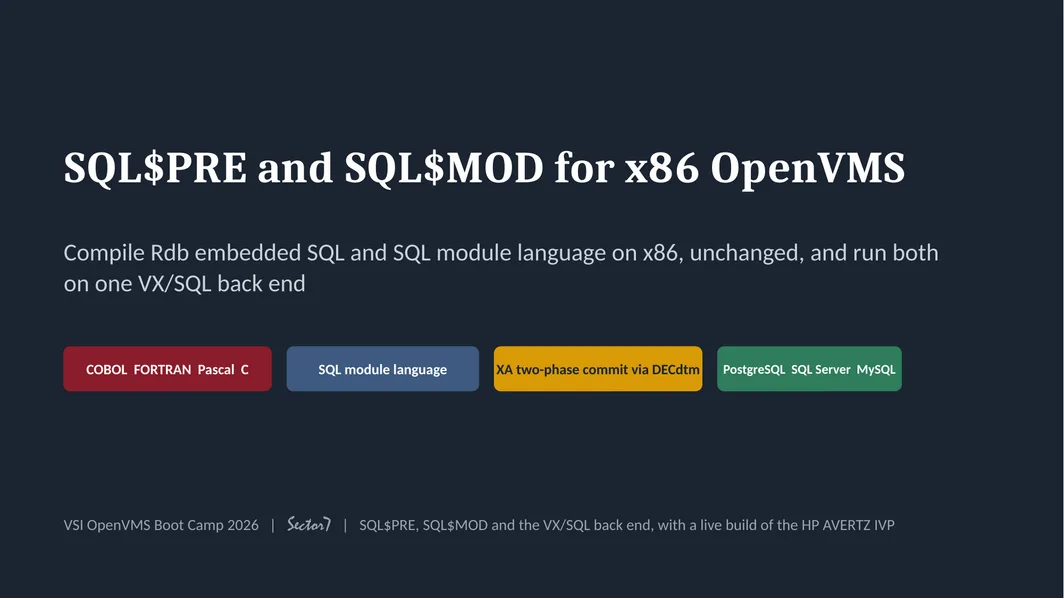 VSI OpenVMS Boot Camp, Portsmouth 2026
- Moving from Rdb to Oracle and PostgreSQL on OpenVMSView the talkTalk · 15 May 2025
 VSI OpenVMS Boot Camp, Malmo 2025
- Migrating RDML & Rdb SQL/SQLMOD to x86View the talkTalk · 27 October 2026
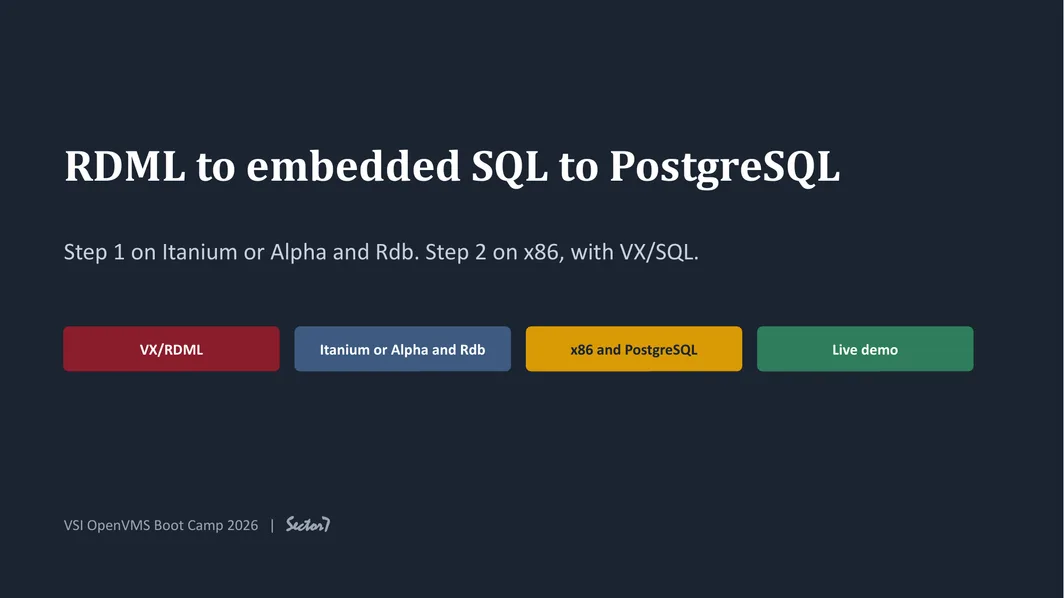 VSI OpenVMS Boot Camp, Portsmouth 2026